
Technological moisture in a new house: how to ventilate in autumn and winter to prevent mold
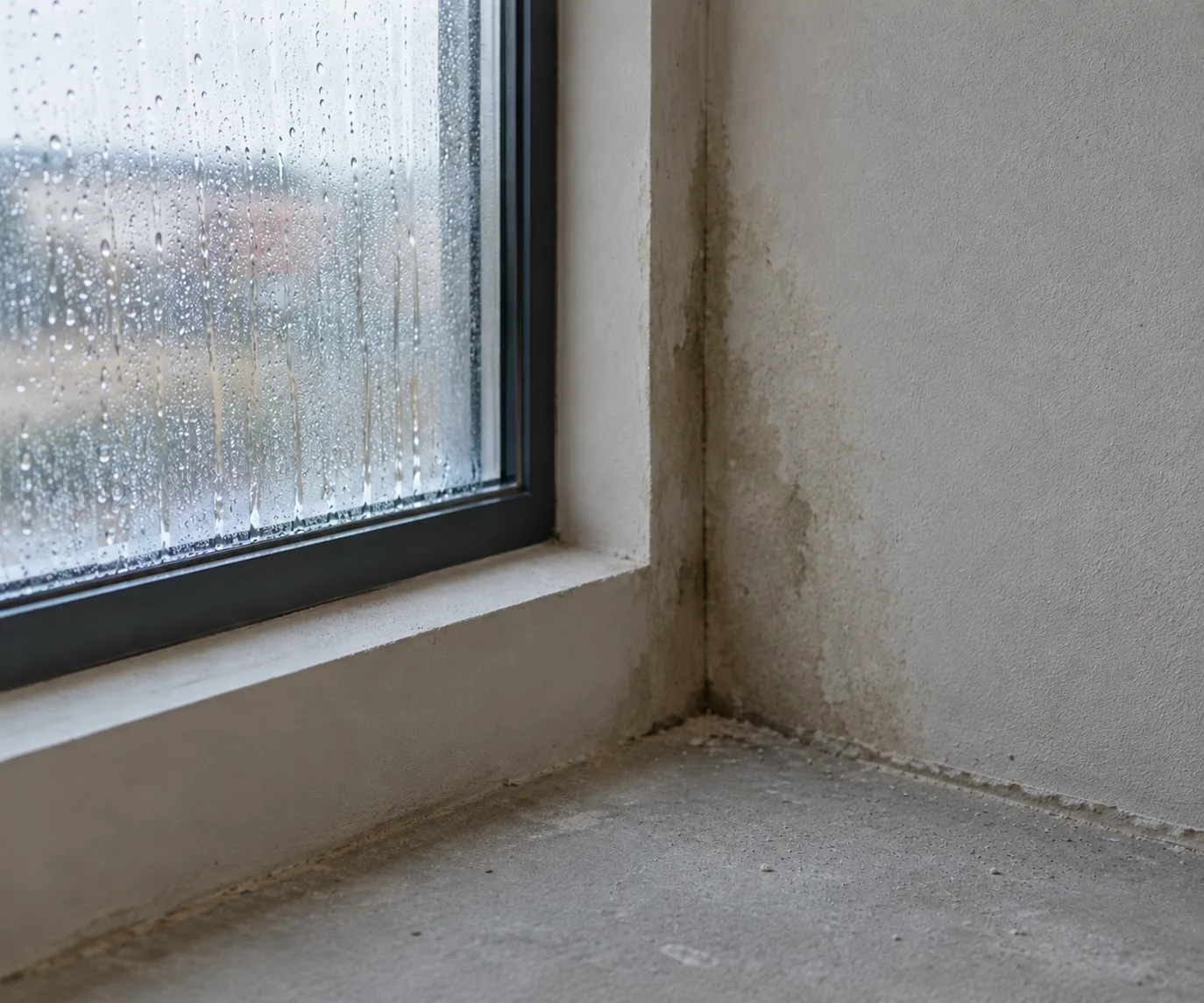
A new house or apartment in its first heating season releases hundreds, and sometimes thousands of liters of water from plasters, floor screeds and walls into the air. This article shows how much water is actually present, how to ventilate and heat properly to avoid condensation and mold, and how to distinguish normal drying from a construction defect.
How much water is really in a new building
The amount of water built into the walls depends primarily on the material. For a typical single-story house with an attic space of approximately 130 m², built with porous ceramic blocks, the technological water in the walls is about 680 liters. With silicate or cellular concrete walls, this amount increases to 4,000–10 000 liters, or six to over ten times more. This results from the production process: ceramic is fired at temperatures above 900°C and leaves the factory drier, while silicates and cellular concrete are created in an autoclaving process and arrive at the construction site heavily saturated with water.
This difference translates directly into the energy needed to dry the partitions: for ceramic it is approximately 462 kWh, for silicates approximately 2,765 kWh, and for cellular concrete as much as 7,340 kWh. This energy must be produced by the building's heating system, and the cost is covered by the investor or resident in utility bills for the first heating seasons. Additionally, a dampened partition has worse insulation parameters, so heat losses through the walls are higher during this time than after complete drying.
The first heating season is critical because this is when the temperature difference between the interior and surroundings is greatest, and moisture from the wall begins to migrate towards cooler surfaces. If the walls were quickly insulated and finished with plaster and tile, the path for water vapor to escape from inside the wall is longer, and the drying process is significantly extended.
- During handover, ask about the material of external and internal structural walls – this is the first information about how much water will need to evaporate.
- For silicate and cellular concrete walls, expect a longer and more expensive first heating season than with ceramic.
The physics of the phenomenon: dew point, thermal bridges, ventilation
Water vapor condenses when it hits a surface colder than the dew point of the air in the room. At a temperature of 20°C and relative humidity of 50%, the dew point is 9.3°C, and at 60% humidity it is already 12.0°C. This means that the higher the humidity in the room, the less a given surface needs to cool down for it to start "sweating" water.
Glass is usually the coldest element in a room, which is why vapor condenses on it first – before it does so on a wall. But exactly the same mechanism works in the corners of external walls, at window frames and where installations pass through partitions – everywhere the temperature of the internal surface is reduced by poor insulation or a thermal bridge. Modern windows are tight and do not exchange air through leaks like old frames do, so without active ventilation or open gravitational ventilation, moisture remains in the apartment and increases.
The threat of mold growth is not determined by the total moisture content of the material, but by freely available water in the pores and on the surface – so-called water activity. The practical alarm threshold is partition moisture at the level of already 5% – from this value the risk of mold and mildew proliferation increases.
How to distinguish a design or execution fault from user habits: if condensation and mold appear pointwise, always in the same place (corner, lintel, pipe passage), regardless of whether the resident ventilates, it is likely a thermal bridge or insulation error. If vapor settles evenly on all windows and cooler walls and disappears after ventilation – this is most often excessively high air humidity resulting from how the apartment is used.
- Measure surface temperature in the suspicious location (pyrometer or thermal imaging camera) and compare it with the dew point calculated for current humidity and air temperature.
- If the surface temperature in the corner is clearly lower than on the flat wall next to it – report it as a suspected thermal bridge, not as a ventilation error.
How to ventilate and heat properly in the first season
In the first year of use, it is recommended to ventilate as frequently as possible: 5–10 minutes in the morning, 2–3 short window openings during the day, and about 15 minutes in the evening. Beyond the first year, the principle of short and intensive ventilation works well – a wide open window for 5–10 minutes, several times a day, instead of long openings, which only cool down walls and sills without effective air exchange.
The target relative humidity in rooms is 40–60%, and in winter it is better to keep the lower limit, i.e. 40–50%. Temperature in living rooms should be 20–22°C, and in bedrooms 18–19°C. Residents produce up to 12 liters of water vapor per day – from cooking, bathing, drying laundry and breathing itself – and this moisture must be removed somehow.
The most common mistakes of the first heating season:
- Completely turning off heating at night or during absence – the wall cools below the dew point and moisture begins to condense on it.
- Blocking radiators with furniture, curtains or a wide sill – warm air does not reach the glass and wall under the window, so this area sweats first.
- Sealing or blocking wall vents and ventilation grilles – without a constant supply of fresh air, opening a window alone is not enough.
- No ventilation for windowless bathrooms – shower moisture remains in the room and migrates to adjacent rooms.
If despite regular ventilation the humidity in the apartment constantly exceeds 60%, a dehumidifier set to 45–50% helps – it supports ventilation but does not replace it. The decisive principle for the first season: ventilate short and often, do not turn off heating completely, keep radiators uncovered and check with a hygrometer that humidity does not rise above 60%.
Checklist for handing over apartment/house to customer
The user manual provided at handover should include a specific ventilation schedule for the first year, not a general recommendation to "ventilate more often". A good example is: 5–10 minutes in the morning, 2–3 short openings during the day, about 15 minutes in the evening, plus information that wall vents should be open and must not be blocked or sealed during renovation without dust protection.
It is also worth clearly stating that defects resulting from improper use of the apartment – including neglected ventilation – are not subject to repairs under warranty. This clause protects both the contractor and the developer from unjustified claims, but only works if the customer received this information in writing before moving in.
The initial condition of the apartment is worth documenting on the day of handover: photos of all rooms, measurement of relative air humidity with a hygrometer and – if possible – measurement of partition moisture in critical places, i.e. corners of external walls and window frames. Such documentation, made with a date, allows you to later unambiguously determine whether a stain appeared immediately or developed during use. Reporting a defect with a photo, description and date in an application such as FixControl has exactly the same effect – a clear record of when and under what conditions a given problem appeared, which makes it easier to resolve a dispute during the warranty period.
- Provide the customer with a ventilation schedule in writing, not just verbally at handover.
- Take and archive photos of the initial condition along with air humidity measurement on the day of key handover.
- Record in the handover protocol the brand and type of vents and information that they should remain open.
When it is already a defect, not a drying process
Natural drying of technological moisture is a process spread over months and sometimes years, and should proceed evenly – air humidity decreases and stains or fog on windows disappears with regular ventilation. A signal of a construction defect is something different: local staining that does not disappear despite ventilation and heating, a musty smell persisting in one room, or point mold always appearing at the same detail – a lintel, corner, or pipe passage through a ceiling.
Such symptoms usually indicate a thermal bridge, an blocked or poorly routed ventilation channel, or an error in the insulation layer at a specific structural element. A photo documenting biological damage in a room corner shows a typical image: excessive partition moisture combined with insufficient ventilation gives mold exactly at that one location, while the rest of the wall remains dry.
Construction moisture from installation leaks is distinguished by dynamics and location. Construction moisture weakens over time and responds to ventilation. A leak from water or sewage installation causes stains that grow or appear suddenly, often near risers, bathrooms or balconies, and do not respond to ventilation or heating the room.
The procedure for reporting a defect during the warranty period should include: the date the problem was first noticed, a photo in good light, a description of conditions (whether the room was ventilated, what the temperature was), and the location on the apartment plan. Such a complete set, recorded immediately – for example as a report in FixControl – allows the contractor or site inspector to quickly assess whether this is still a drying process or already a defect to be removed under warranty.
- If a stain does not respond to two weeks of regular ventilation and heating – report it as a suspected defect, do not wait until the end of the season.
- Check if stains coincide with the course of water or sewage installation – if so, first rule out a malfunction before considering it a technological moisture issue.
Sources
- Engineering Construction: Fast construction – which material to choose for building walls — https://inzynierbudownictwa.pl/szybka-budowa-ktory-material-wybrac-do-wznoszenia-scian/
- Engineering Construction: Molds in buildings - growth conditions, effective removal — https://inzynierbudownictwa.pl/grzyby-plesniowe-w-budynkach-warunki-rozwoju-skuteczne-usuwanie/
- Oknoplast: Why windows get wet and what you can do about it — https://oknoplast.com.pl/blog/dlaczego-okna-sa-mokre-i-co-mozesz-z-tym-zrobic/
- Monday Development: APARTMENT USE INSTRUCTIONS — https://www.mondaydevelopment.pl/sites/default/files/pliki/fj3_Instrukcja%20u%C5%BCytkowania%20lokalu%20mieszkalnego.pdf